Overview Summary
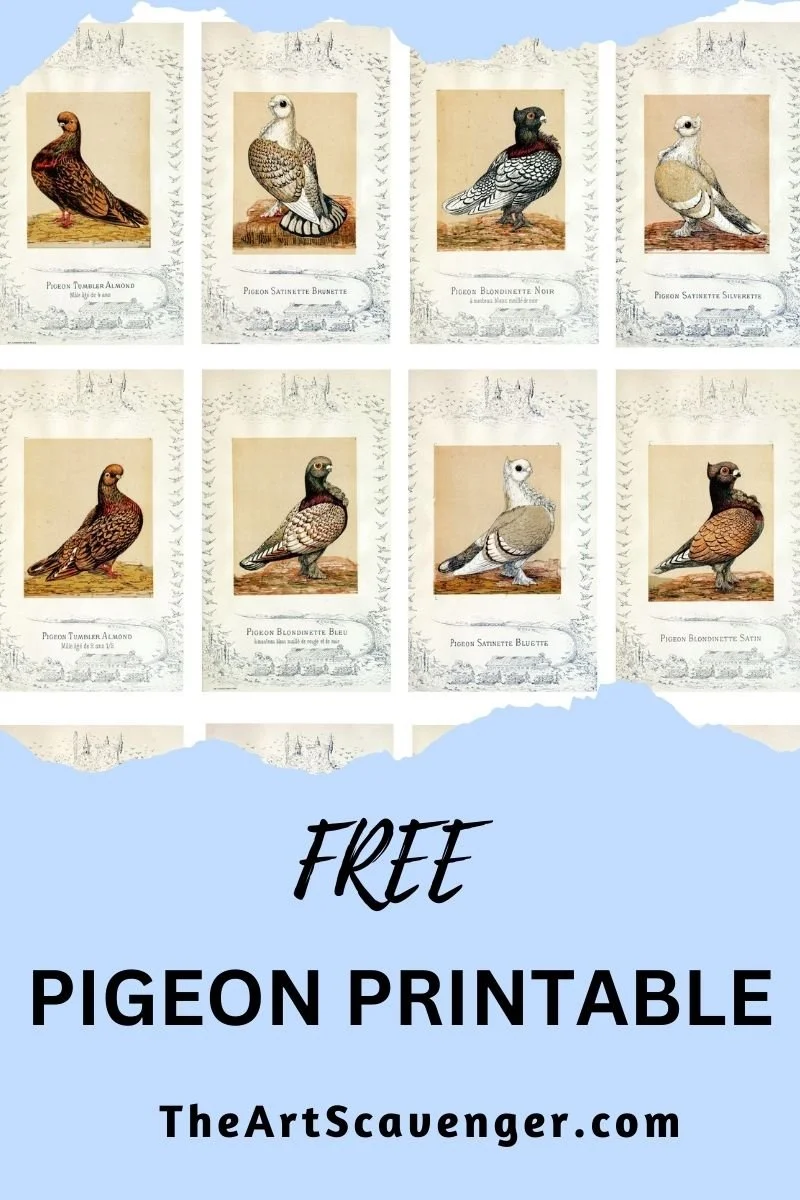
These free printable pigeon illustrations come from the 1883 French book Monographie des Pigeons Domestiques.
The book documents domestic pigeon breeds through detailed 19th-century scientific engravings.
The artwork reflects Victorian-era natural history illustration techniques.
The images are in the public domain and free for creative and educational use.
This printable collage sheet includes multiple labeled antique pigeon breed plates.
Perfect for junk journals, art journals, scrapbooking, cottagecore crafts, and natural history-themed projects.
Meet the Most Elegant Pigeons You’ve Ever Seen
Let’s be honest.
When most people hear the word “pigeon,” they picture a bird eyeing their sandwich in a parking lot.
But in 1883 France? Pigeons were refined. Studied. Illustrated with care.
The images in this free printable collage sheet come from Monographie des Pigeons Domestiques, a beautifully detailed French natural history book devoted entirely to domestic pigeon breeds.
And these birds are not casual. They pose. They radiate Victorian-level self-importance.
What Is Monographie des Pigeons Domestiques?
Published in 1883, Monographie des Pigeons Domestiques (“Monograph of Domestic Pigeons”) is a 19th-century French ornithology volume dedicated to cataloging pigeon varieties.
During the Victorian era, pigeon breeding was wildly popular across Europe. Enthusiasts carefully developed and documented:
Feather color variations
Tail structures
Breast shape
Head crests
Posture and stance
Books like this served as breed references — part agricultural manual, part scientific documentation, part aesthetic celebration.
The illustrations were engraved in the classic natural history style of the late 1800s: precise linework, subtle shading, balanced composition, and labeled plates for identification.
In other words, these weren’t doodles. They were research.
Why 19th Century Scientific Bird Illustrations Are So Beautiful
Before photography became standard in print, scientific illustration carried the weight of documentation.
Artists collaborated with naturalists to ensure anatomical accuracy. That’s why antique ornithology engravings often feel both artistic and technical.
Notice in these pigeon plates:
The careful rendering of layered feathers
The defined foot placement
The consistent profile poses
The neutral background that highlights the bird’s form
Everything is intentional.
And that clean composition is exactly what makes these vintage pigeon illustrations so useful in modern design projects.
What’s Included in This Free Collage Sheet
This printable sheet features multiple pigeon breed illustrations from Monographie des Pigeons Domestiques, including labeled varieties such as:
Pigeon Tumbler Almond
Pigeon Sainette Brunette
Pigeon Blondinette Noir
Pigeon Carrier Anglais
And other documented domestic breeds
Each image preserves the 19th-century engraving style, complete with French breed labeling and classic plate formatting.
The overall aesthetic:
Neutral antique background tones
Detailed black linework
Warm natural coloring
Elegant specimen-style layout
It feels like a museum plate, but printable.
Are These Antique Pigeon Illustrations Public Domain?
Yes.
Because Monographie des Pigeons Domestiques was published in 1883, its illustrations are in the public domain in the United States.
You can use them for:
Junk journaling
Art journaling
Scrapbooking
Mixed media collage
Printable stationery
Classroom projects
Commercial craft designs (always verify usage laws in your country)
No permissions required. Just print and create.

Creative Ways to Use Vintage Pigeon Engravings
Now let’s make this practical.
1. Victorian Naturalist Junk Journal Spreads
Layer these pigeon plates with:
Antique ledger paper
French dictionary text
Faux specimen tags
Handwritten “field notes”
Instant 19th-century naturalist aesthetic.
2. Cottagecore and Rustic Scrapbooking
Despite their modern reputation, pigeons were once farm and garden companions.
Pair these prints with:
Pressed botanical imagery
Soft linen-textured backgrounds
Sepia-toned accents
You’ll get a quiet, heritage-inspired look.
3. Mixed Media Art Projects
Because the engravings have strong contrast, they respond beautifully to:
Tea staining
Light watercolor washes
Metallic ink highlights
Matte varnish layering
You can even cut out individual breeds and use them as focal collage elements.
4. Educational Use
If you’re teaching about:
19th-century agricultural practices
European natural history publishing
Scientific illustration before photography
Animal domestication
These pigeon plates offer accessible visual primary sources.
They’re not just decorative. They’re historical documentation.
Why Pigeon Breeding Was So Popular in the 1800s
Quick history tangent.
In the 19th century, pigeon breeding became both a hobby and a competitive pursuit. Breeders selectively developed dramatic traits such as fan tails, puffed chests, ornate head crests, and then documented them in illustrated volumes like Monographie des Pigeons Domestiques.
These books preserved breed standards in visual form.
Without them, many lesser-known domestic pigeon varieties might have faded into obscurity.
So technically, your printable collage sheet is also a tiny act of preservation.
More Free Printables You Might Like
If antique natural history illustrations are your weakness, you may also enjoy:
Free Bird Illustration Printables – A collection of vintage bird illustrations perfect for nature-themed journal spreads.
Free Mushroom Printables – Scientific mushroom illustrations that pair beautifully with naturalist layouts.
Free Bird and Eggs Printables – Delicate antique bird and egg engravings ideal for layered specimen-style pages.
Free Vintage Sea Shell Ephemera Printables – Detailed marine engravings that complement Victorian natural history themes.
All of these blend seamlessly with scientific bird plates.
Frequently Asked Questions
What does Monographie des Pigeons Domestiques mean?
The title translates to “Monograph of Domestic Pigeons.” It is a detailed 1883 French book documenting pigeon breeds.
Are these pigeon images really from 1883?
Yes. The illustrations originate from the 1883 publication and reflect late 19th-century French natural history engraving techniques.
Can I use these pigeon illustrations for commercial products?
Because they are in the Public Domain, commercial use is generally allowed in the U.S. Always confirm regulations in your region.
What style of artwork are these?
They are Victorian-era scientific engravings typical of natural history books — precise, labeled, and anatomically detailed.
Why are the birds posed in profile?
Profile positioning allowed breeders and naturalists to clearly compare body structure and feather patterns across pigeon varieties.
Final Thoughts
Pigeons may not have the glamorous reputation of peacocks or swans. But in 1883 France, they were worthy of a full-length monograph and carefully engraved plates. That kind of attention says something.
These illustrations capture a moment when science, hobby culture, and artistry intersected, and now you get to reuse that history in your own creative projects. Which, honestly, feels like giving these dignified Victorian birds the spotlight they deserve.
You may also enjoy these free collage sheets.