Quick Summary
The 1900 Paris Exposition (Exposition Universelle) included a groundbreaking display titled the “Exhibit of American Negroes.”
The exhibit was organized by W.E.B. Du Bois and Thomas J. Calloway.
It presented photographs, charts, and data documenting African American life at the turn of the 20th century.
The goal was to challenge racist stereotypes and demonstrate Black progress since emancipation.
The photographs from the exhibit are now in the public domain.
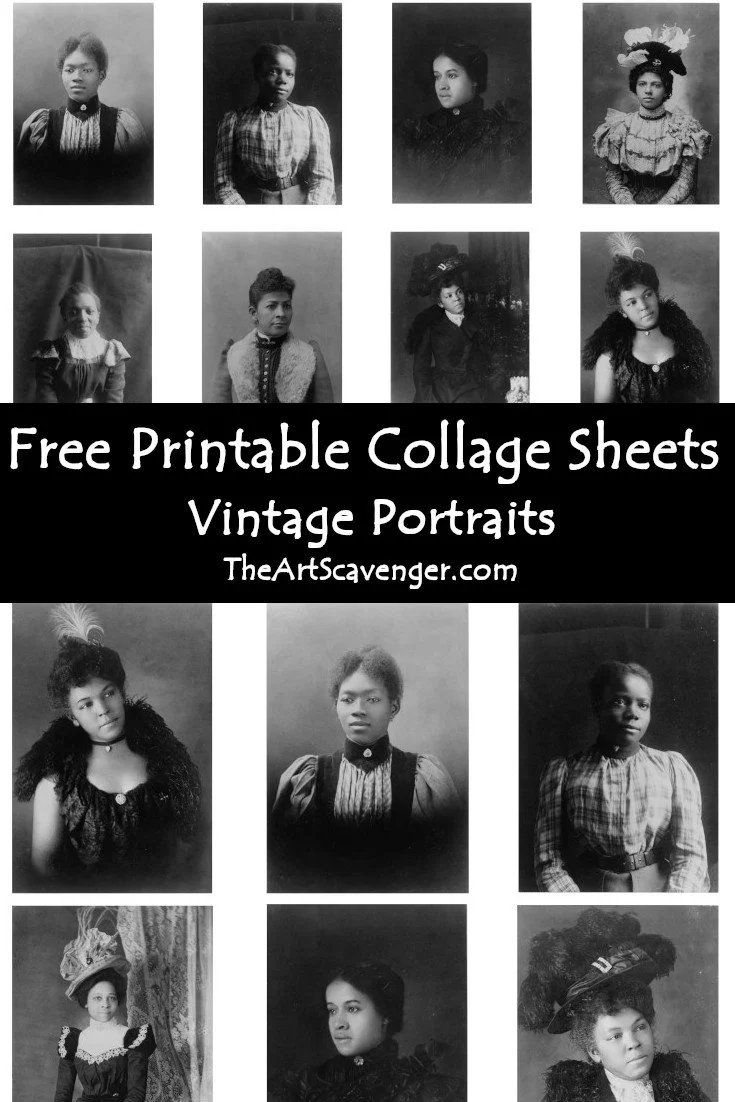
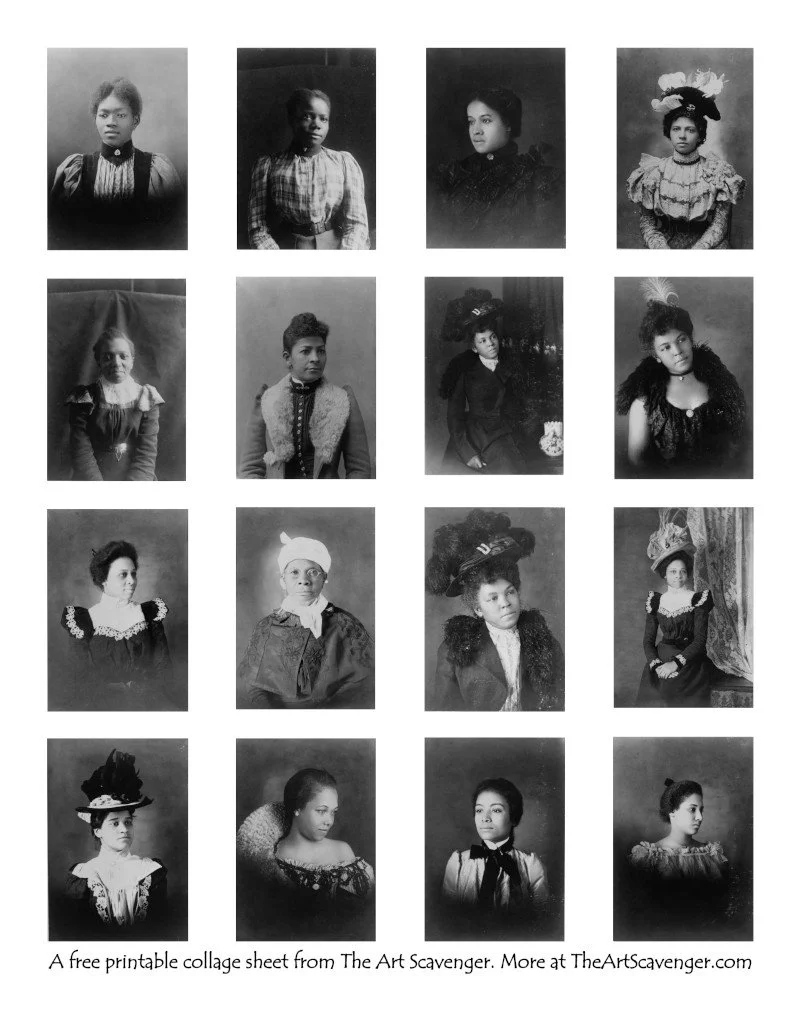
This post includes two free printable collage sheets made from images originally displayed at the 1900 Paris Exposition.
These historical photographs can be used for research, classroom projects, junk journals, art journals, scrapbooking, and mixed media art.
The 1900 Paris Exposition and the "Exhibit of American Negroes"
The Exposition Universelle, better known as the 1900 Paris Exposition, was a massive world’s fair designed to showcase technological innovation, art, culture, and national achievements at the dawn of a new century.
Tucked inside that international spectacle was something extraordinary: the “Exhibit of American Negroes.”
Curated by sociologist, historian, and civil rights pioneer W.E.B. Du Bois, along with U.S. Special Commissioner Thomas J. Calloway, the exhibit documented African American life in the decades following emancipation.
Instead of caricatures or stereotypes that were common in American media at the time, this exhibit presented:
Formal studio portraits
Family photographs
Images of businesses and schools
Statistical charts and infographics
Documentation of professional and middle-class Black communities
It was bold. It was intentional. And it was strategic.
By presenting this exhibit in Paris, Du Bois and Calloway were speaking to an international audience, positioning African American progress within a global conversation.
Why the 1900 Exhibit Was Historically Significant
This was not just a photo display. It was an act of intellectual resistance.
At a time when Jim Crow laws were expanding in the United States, the Exhibit of American Negroes offered visual evidence that contradicted white supremacist narratives.
The photographs were carefully selected to demonstrate:
Educational advancement
Economic stability
Professional achievement
Strong family structures
Community leadership
In modern terms, we might call this a data-driven counter-narrative.
Du Bois understood the power of images. Photography functioned as primary source documentation — proof that could not easily be dismissed.
Today, these images are considered important examples of early African American documentary photography and historical primary source material.
And now, more than a century later, many of these photographs are in the public domain.
Are These 1900 Paris Exposition Photographs Public Domain? Yes.
The images included in this printable set originate from 1900 and earlier. Due to their age, they are part of the public domain in the United States.
That means you can:
Print them
Use them in classroom presentations
Incorporate them into research projects
Create mixed media art
Add them to junk journals
Include them in scrapbooks
Use them in educational materials
You are not just decorating with vintage imagery. You are working with historical documentation. That’s a powerful distinction.
What’s Included in These Free Collage Sheets
This download includes:
Two high-resolution printable collage sheets
Carefully restored black and white photographs
A selection of portraits from the 1900 exhibit
Turn-of-the-century African American studio photography
The aesthetic is striking: formal clothing, dignified posture, composed expressions. These are portraits meant to communicate stability and self-possession.
If you’re used to typical “vintage photo printables,” this set carries more historical weight. It invites thoughtful use.

How to Use These Historical Photo Printables
Let’s talk practical application.
1. Junk Journaling with Historical Depth
Instead of generic Victorian portraits, you can create themed spreads around:
Turn-of-the-century America
Black history documentation
Early 20th century education
World’s fairs and global exhibitions
Pair these images with:
Ledger paper
Old maps
Typewritten quotes from Du Bois
That layering creates context instead of decoration.
2. Art Journaling and Mixed Media Projects
These photographs work beautifully in:
Social justice–themed art journals
Heritage-inspired collage art
Narrative mixed media spreads
Storytelling layouts focused on resilience
You could even incorporate statistical graphics inspired by Du Bois’ original data visualizations for a historically layered composition.
3. Classroom and Homeschool Use: Primary Source Images for Teaching African American History
If you’re a teacher or homeschool parent looking for African American primary source images, these photographs from the 1900 Paris Exposition can be powerful classroom resources.
The “Exhibit of American Negroes” was designed as educational material from the beginning. Today, those same images can help students:
Analyze early 20th-century African American life
Examine how photography can challenge stereotypes
Compare American race relations in 1900 to today
Study the global context of the 1900 world’s fair
Explore the work of W.E.B. Du Bois beyond his written scholarship
Because these images are in the public domain, they can be used in:
Black History Month lesson plans
U.S. history units on Reconstruction and Jim Crow
PowerPoint or Google Slides presentations
Research papers and digital humanities projects
Classroom displays or bulletin boards
If you’re teaching about world’s fairs, civil rights history, or the sociology of representation, these photographs offer students a rare opportunity to work directly with historical visual evidence.
Primary sources make history tangible. Instead of simply reading about the period, students can analyze the faces, clothing, posture, and presentation choices in the photographs themselves.
That kind of visual literacy builds stronger critical thinking skills.
4. Genealogy and Family History Inspiration
Researchers and family historians often look for contextual imagery from the era they’re studying.
These photographs provide:
Authentic 1900-era dress references
Studio photography examples
Visual context for turn-of-the-century African American communities
Even if they aren’t direct ancestors, they offer visual atmosphere for heritage storytelling.
The Power of Photography as Primary Source
One of the reasons this exhibit still matters is because photography functions as evidence. A written report can be ignored. A photograph demands acknowledgment.
The images from the 1900 exhibit quietly say:
“We were here. We were educated. We built businesses. We raised families.”
That’s why these photographs continue to resonate.
And when you incorporate them into creative work, you’re engaging with visual history, not just decorative ephemera.
More Free Printables You Might Like
If you enjoy working with historical imagery, you might also love:
(These pair beautifully with early 1900s photography spreads.)
Frequently Asked Questions
Who organized the African American exhibit at the 1900 Paris Exposition?
The exhibit was organized by W.E.B. Du Bois and Thomas J. Calloway, who served as U.S. Special Commissioner in charge of the exhibit.
What was the goal of the Exhibit of American Negroes?
The goal was to document and present the social, economic, and educational progress of African Americans since emancipation. It was designed to counter racist stereotypes with visual and statistical evidence.
Why was the exhibit shown in Paris?
The 1900 Paris Exposition offered an international platform. Presenting the exhibit abroad allowed organizers to frame African American progress within a global conversation about modernity and civilization.
Are these photographs really in the Public Domain?
Yes. Because the photographs were created in 1900 or earlier, they are in the public domain in the United States.
Can I use these images for commercial projects?
Public domain status generally allows commercial use, but always verify the specific licensing rules for your country and intended use.
Final Thoughts
This isn’t just another vintage photo download.
These images were part of a carefully constructed historical statement, one that pushed back against dominant narratives of its time.
When you print them, journal with them, teach with them, or collage with them, you’re participating in the continued visibility of that history. And that’s meaningful.
Creative work can be decorative, but it can also be reflective. This set leans toward the reflective.
You may also enjoy these free collage sheets.